
A Curriculum for Social Emotional Learning that Doesn't Turn Class Into Therapy
- Robert Vint
- Dec 14, 2025
- 3 min read

Social-emotional learning is now part of most classrooms, but many teachers feel uncomfortable teaching it. Not because SEL isn’t important, but because it can start to feel too personal, too emotional, or too close to therapy — something many teachers were never trained (or hired) to do. However, the good news is that SEL does not need to look like therapy to be effective. Learn how to choose a A Curriculum for Social Emotional Learning that Doesn't Turn Class Into Therapy.

Why Social and Emotional Learning Sometimes Feels Like Therapy
Many SEL lessons blur the line between learning and therapy by asking students to:
Share deeply personal experiences
Talk openly about emotions or trauma
Process feelings in front of peers
Reflect deeply on their inner lives
Often, they are asked to do this immediately after learning about science, or even sometimes during subject area classes, as many SEL programs stress the importance of embedding lessons into other subject areas!
While this can be appropriate in counselling settings, it can feel risky or uncomfortable in a classroom — especially with:
Large class sizes
Diverse cultural norms
Students who don’t feel safe sharing
Teachers without clinical training
30 minutes before math in front of their peers is not the appropriate time to have a student disclose a traumatic experience from their past and process the accompanying feelings. (Read: Emotional Check Ins - Naming or Shaming)
When SEL feels like therapy, students often:
Shut down
Joke or disengage
Resist participation
Feel exposed rather than supported
Experience additional stress that interferes with learning
The classroom isn’t the place to explore our student’s most challenging moments.
What SEL Is (and Is Not)
At its core, SEL is skill-building, not treatment. It helps students develop skills that support well-being and resilience, without diagnosing or treating mental disorders.
Effective classroom SEL focuses on helping students:
Notice what’s happening internally
Understand how thoughts and feelings affect behaviour
Learn healthy responses
Make choices aligned with what matters to them
This can be done in a way that does not require digging into students’ personal histories or requiring public or group emotional disclosure. In SEL, the teacher’s role is not to “fix” how students feel. Rather, it is to give students tools to help them recognize what they are experiencing, accept it as part of being human, and choose actions that support what matters to them.
A Skill-Based Approach to SEL
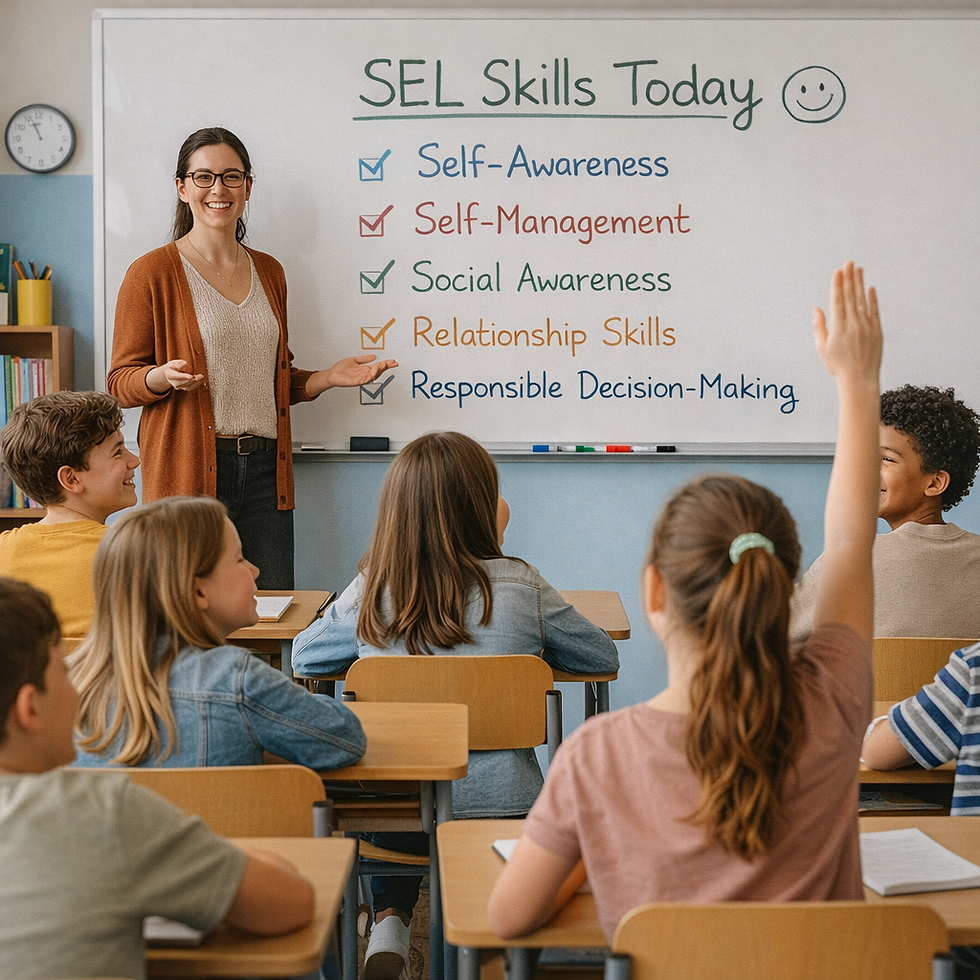
One way to keep SEL firmly in the classroom (and out of therapy territory) is to focus on skills students can practice, not feelings they must explain. Skill-based Social-Emotional Learning (SEL) focuses on explicitly teaching and practicing core competencies such as self-awareness, self-management, social awareness, relationship skills, and responsible decision-making. Students build concrete skills for responding to emotions, stress, and social situations across everyday school contexts, rather than focusing only on emotional awareness.
A skills based approach can be accomplished without relying on oversharing. SEL is most effective when
it helps students recognize their internal experiences, accept them and take action aligned with what matters. This can be done without requiring personal disclosure or emotional analysis, using brief, predictable lessons that keep the teacher’s role focused on skill development rather than fixing feelings.
Where RAD Fits In
RAD (Recognize–Accept–Do) was created with this exact concern in mind.
RAD lessons:
Are non-clinical and classroom-appropriate
Are designed for busy teachers to implement immediately
Allow teachers new to SEL to learn as they go
Focus on skills students can practice independently
Avoid emotional disclosure
Fit into 30 minutes or less
Align with Core Competencies and CASEL (Read: Does My SEL Program Align With CASEL?)
Each lesson includes a short video, student worksheet, and a teacher companion to support implementation.
Final Thought
SEL doesn’t need to feel awkward, heavy, or therapeutic to be meaningful.
When taught as a set of practical life skills, SEL can support students while respecting boundaries — and help teachers feel confident doing the work they’re already doing well.


Comments